
tunnel topo pt.2
preliminary results from the A train
Sometimes the deepest subway platforms in NYC feel less like transit spaces than atmospheric conditions. The air thickens gradually as you descend: first heat, then an intermingling of metal, smoke, and human smells, then the stale compression of the subterranean. For me, the relative depth of a platform has always seemed to have a sort of placebo effect: the deeper I go, the more engulfed I feel, and the more shallowly I breathe, a semi-conscious effort to protect myself from some imagined danger. I know you do this too.
tunnel topo pt. 1 describes my endeavor to measure how pollution behaves—and whether depth matters—on the NYC subway. Here, I share preliminary results.
My study was a small pilot. Over the course of one day, I moved through Manhattan on the A train carrying a particulate monitor and logging train behaviors and platform elevations by hand. I was studying PM2.5: microscopic airborne particles [particulate matter] small enough [aerodynamic diameter of 2.5 micrometers] to penetrate deep into the lungs and, in some cases, enter the bloodstream. In subway systems, these particles are produced partly through friction (steel wheels grinding against rails, brakes shedding metallic dust) and trapped by the built environment (tunnels with questionable ventilation). Previous studies had already shown elevated particulate matter in subway environments. I wanted to know whether depth mattered to.
The stations I selected each contained two vertically separated underground platforms. At every stop, I sampled air on the upper platform, the lower platform, and outside at street level. I carried a SidePak aerosol monitor within what researchers call the breathing zone (the area around the face). I recorded train movements second by second, marking when trains entered stations and when they left, curious whether the movement of the trains themselves altered the atmosphere around waiting passengers.
Descriptive analysis showed that the deeper platforms consistently showed the highest concentrations of PM2.5. Street-level air was generally cleaner, though often not clean enough. Nearly every location I measured exceeded the recommended exposure guidelines. But what surprised me most in the descriptive statistics was that PM2.5 levels often fell slightly when trains entered the stations. The same machinery generating metallic pollution also appeared to temporarily circulate and disperse the air underground.
To better understand these relationships, I conducted statistical analyses (using SAS) examining how PM2.5 varied across subway microenvironments (lower platform vs. upper platform vs. street) and in relation to train movement. The analysis showed statistically significant differences across platform levels (ANOVA: F(2,137)=4.32, p=0.015), with the highest levels generally observed on deeper underground platforms. Differences with train arrivals and departures did not reach statistical significance (Satterthwaite-adjusted p=0.065), suggesting that my data regarding train movement may have reflected coincidence.
To better understand how pollution changed with depth, I mapped each station vertically alongside its measured PM2.5 concentrations. The figure below shows average PM2.5 levels and variability across lower platforms, upper platforms, and street-level entrances, revealing how the atmosphere often intensified deeper underground. Variability is captured by the white error bars, which represent standard deviations (a statistical measure of how much measurements fluctuated around the average), highlighting the considerable variability of subway air across places and moments in time.
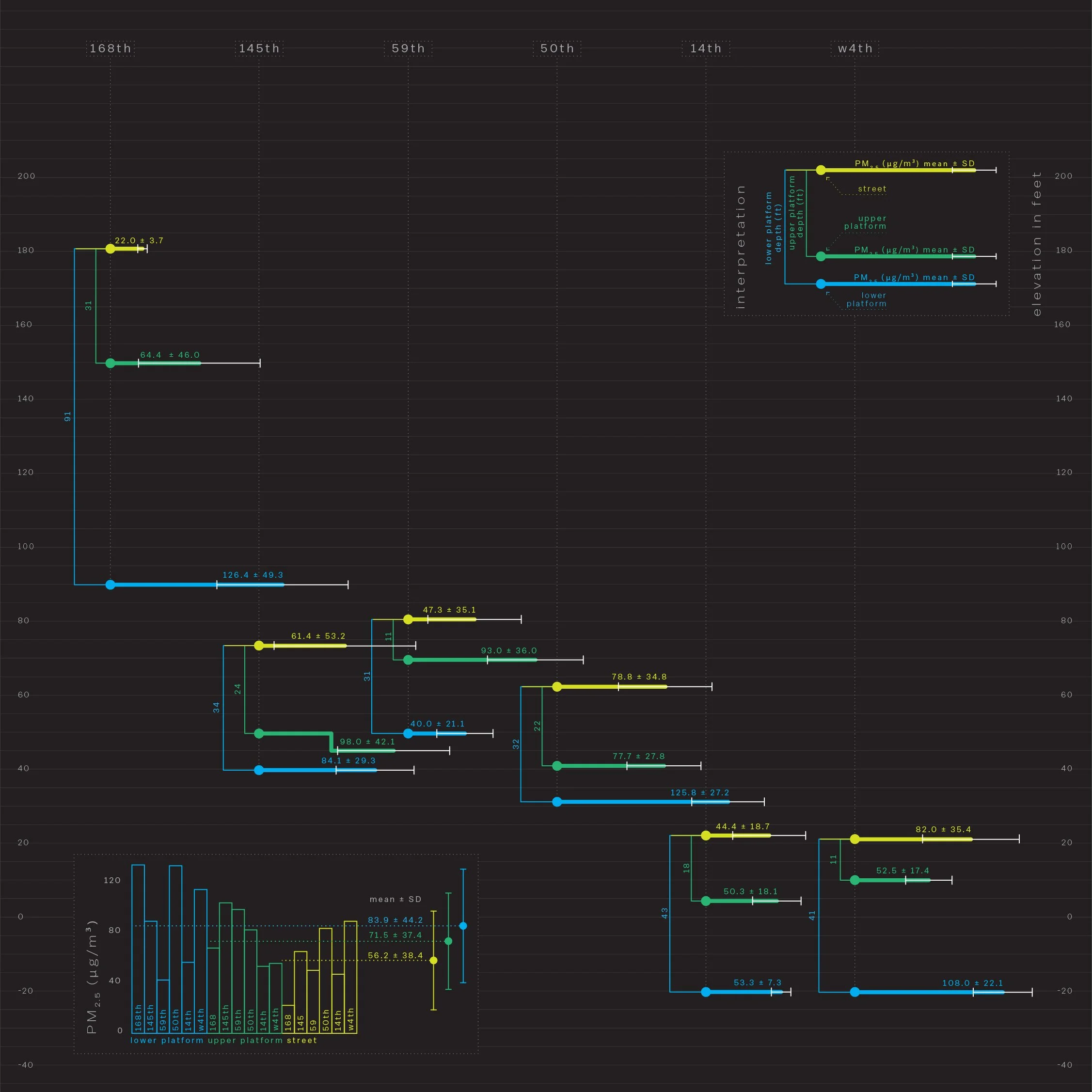
Ultimately, the data was messy. PM2.5 concentrations fluctuated substantially not only between station microenvironments but also within the same platform over relatively short periods of time. Subway environments are highly dynamic atmospheric systems shaped by train frequency, braking intensity, tunnel design, ventilation, passenger density, temperature, and air circulation.
Because I conducted this study over a single day with relatively short sampling periods, the measurements should be understood as snapshots rather than definitive characterizations of station air quality. The sample size was limited, station-specific factors could not fully be controlled, and one-minute averaging intervals may have smoothed over sharper spikes occuring in real time. Still, the consistency of elevated PM2.5 concentrations across deeper platforms suggests that even brief measurements can reveal important features of how PM behaves beneath the city.
