dengue dynamics
how might we think? green infrastructure and mosquitoes
This week, I have the pleasure of attending the International System Dynamics Conference in Delft, Netherlands. Ok, I’m participating remotely from New York, but still, the conference provides a *surprisingly welcoming hybrid environment* that makes me feel (aside from the horrific time zone change that has me attending in the middle of the night) *almost* like I’m there.
This morning I presented a work-in-progress model about dengue fever. Already prevalent in tropical cities worldwide, dengue is the most rapidly expanding mosquito-borne disease on the planet. It is transmitted by mosquito species in the Aedes genus (most notably Aedes aegypti and Aedes albopictus).
On the surface, my project may look like a project about these mosquitoes. But it’s actually so much more. It’s a project about urban design and policy. It’s also a project about how we think.
When most people — including policymakers — think about dengue, the image of an Aedes mosquito, swollen with dengue-infected blood and on its way to indulge in its next blood meal from an unwary human victim, comes to mind. The common response is equally straightforward: kill the mosquitoes.

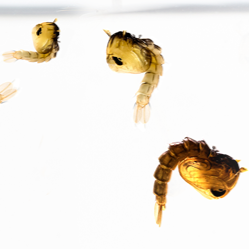
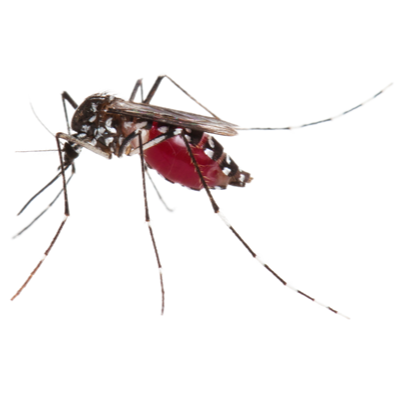
Above from left: Aedes aegypti, a common culprit of spreading dengue fever, at larval, pupal, and adult stages
That logic has shaped public health efforts for decades. Spray insecticides —> kill mosquitoes —> reduce disease.
If only it were so simple. My background applying the principles of landscape architecture and public health in Iquitos, a city where dengue surges seasonally, lead me to the issue of dengue. From these perspectives, etiology is never so simple. To curb dengue epidemics, we must understand mosquitoes in context. This means shifting our focus from biomedical etiology to ecological etiology.
Let’s back up and examine that word.
Etiology is the scientific study of causation. Its roots are ancient Greek: aitia (reason) + logia (study of) = “giving reason to.”
IMHO, etiologies too-often focus on the *very last step* in causation. In the case of dengue, this is the moment where the mosquito bites you, or even when the dengue virus enters your bloodstream — what I’m calling biomedical etiology. Indeed, absurd attention has been paid throughout history to describing these microscopic phenomena (identifying pathogens, naming them after old white men, photographing them), with scant regard for the larger context.
Here’s the problem: by the time a dengue-carrying mosquito bites you, so many other [preventable] things have already happened! By focusing on biomedical etiology, we miss opportunities to address all those other things that set up the circumstances for dengue infection.
*All those other things* are the stuff of what I like to call ecological etiology.
Ecological etiology treats the context of a disease like an ecosystem. These ecosystems are complex, layered, and replete with inter-dependent systems acting in sociocultural, environmental, political, biomedical, and other realms. An exploration of ecological etiology evokes creative, interdisciplinary thinking. In ecological etiology, we ask bigger questions:
Not only
what is the virus that causes dengue?
which mosquitoes spread dengue?
but also,
how does the weather contribute to dengue?
how does housing contribute to dengue?
how does social inequality contribute to dengue?
from ecology to systems
In my recent work and studies, I have had the opportunity to learn about system dynamics (sd) modeling, an approach practiced by CUNY SPH professors Nasim Sabounchi and David Lounsbury. My first exposure to sd was working as a geospatial analysist with a team lead by Dr. Sabounchi on an NIH-funded project exploring the opioid crisis — a complex health topic necessitating attention well beyond the biomedical (the effect of opioids on the human body). I worked alongside systems dynamicists, impressed by their ability to examine variables like opioid access, emergency care, law enforcement, stigma, economics, politics, and multiple medical interventions all at once.
I later enrolled in an sd modeling course where I delved into the lingo, learned to read models, and practiced building my own. What I love about sd is that it drives our progression from ecological thinking to systems thinking. We move from describing the ecosystem — the underlying contexts shaping phenomena like opioid use disorder or dengue fever — to examining how pieces of the ecosystem interrelate. We ask even bigger questions:
Not only
what are the layered contexts contributing to dengue?
but also,
how do these pieces influence one another over time?
Thinking in feedback
This shift in perspective drew me to apply sd modeling to dengue. I can explain why.
Consider this scenario: Cities create habitat for mosquitoes. Climate shapes breeding seasons. Human behavior affects exposure. Insecticide spraying suppresses mosquito populations.
None of these factors operates in isolation. They are constantly interacting. What’s more, they are constantly changing. They constantly shift. Imagine trying to solve a puzzle where every piece keeps changing shape as you connect it to another piece. Let us consider each piece.
Cities create habitat for Aedes mosquitoes. This is due to a combination of factors: deforestation and pavement contribute to the hot microclimates and standing water necessary for Aedes breeding; dense human populations provide food (read human blood). But each of these elements of cities is constantly in flux. Cities are growing, people are moving, neighborhoods are changing, street trees are constantly being planted, growing, dying.
Climate shapes breeding seasons. Climate change is shifting climate, shattering our expectations regarding breeding seasons, which may be longer, shorter, more sporadic than what predictions based on historic climate data ever imagined. Breeding cycles are sped up by higher temps, to a point. All aspects of climate are in flux.
Human behavior affects exposure. People know that being bit by mosquitoes is not ideal. We know that, beyond discomfort, mosquitoes bring infections. We can prevent being bit by using repellent, wearing protective clothing, and sleeping under mosquito nets. But our access to these preventative measures is inconsistent. Repellant and bed nets may be out of reach. We may find ourselves unable to quarantine from infected family members. We may face behavioral pressures that shape our exposure.
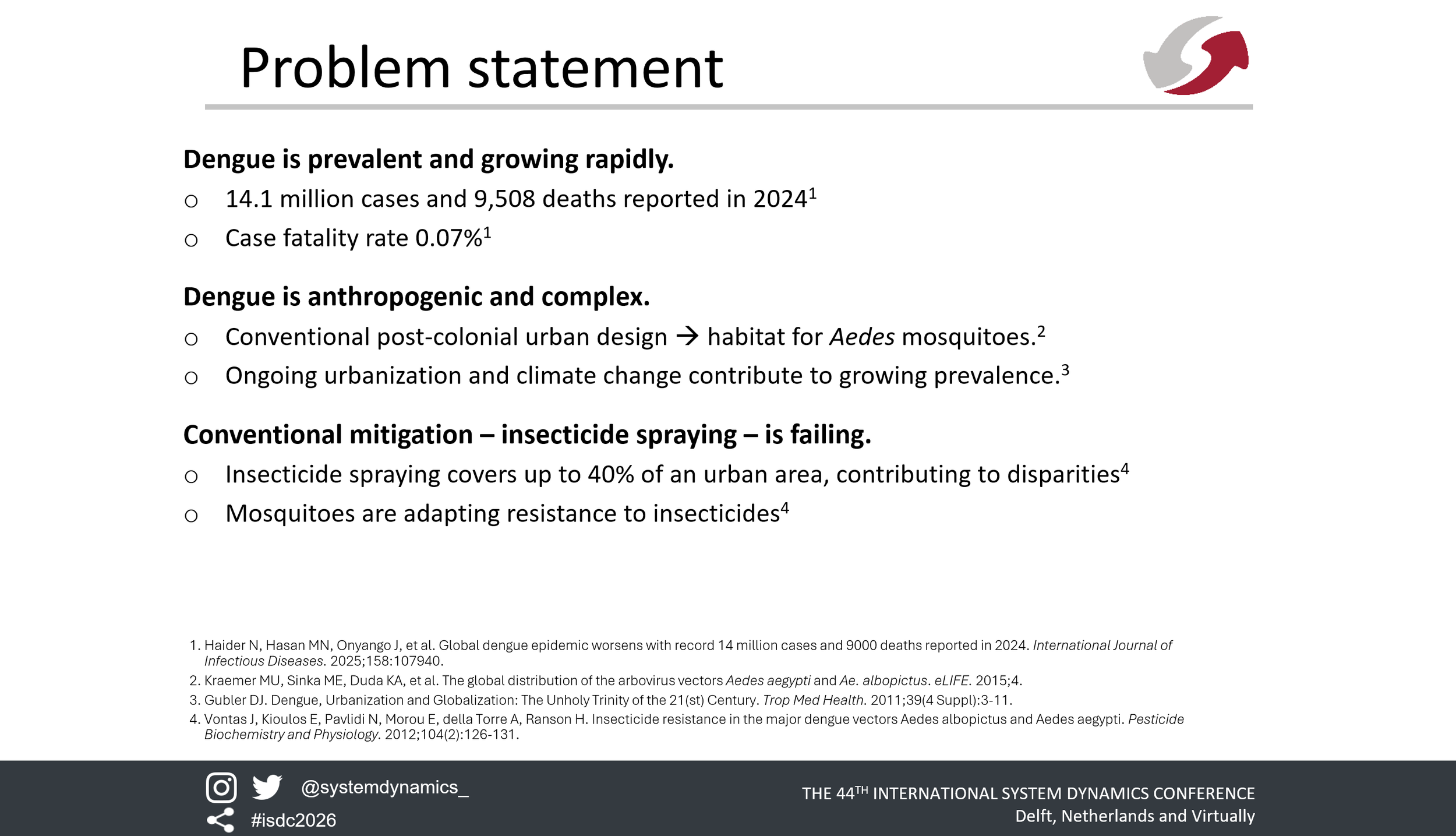
Insecticide spraying supresses mosquito populations. True, in the short-term. However, insecticide spraying reshapes mosquito habitat in ways that are not immediately obvious — ways that may ultimately support AEDES populations. For one, insecticide spraying creates evolutionary pressure for resistance. Evidence capturing Aedes resistance to pesticides is mounting. Furthermore, insecticide spraying can suppress ecosystem functioning. Insecticides may also suppress Aedes predators, many of whom adapt more slowly than mosquitoes. Removing Aedes predators could create the circumstances for them to thrive. (A fellow conference-attendee alerted me to an excellent example of this: parachuting cats in Borneo.) Finally, repeated exposure to pesticides can have deadly effects on humans. The evidence (re. cancers, dementias, thyroid disorders, etc.) continues to mount.
Modeling these four factors as static variables would be useless. Each is comprised of interrelated subsystems in flux. In-turn, each is in flux, as are the interactions between them.
SD modeling is designed to capture these feedback loops. In doing so, a good model can deepen our questions. Our questions may become deeply useful. And we may even be able to explore answers.
Full disclosure: I’m here for the green infrastructure.
Dengue is most interesting to me because it’s all about landscape. Landscape architects are inharently trained to think in systems over time. Throughout the design process, from research through implementation, we consider human and non-human processes. We consider layered histories (thick sections), all the stuff of society (sociocultural, economic, transportation, and health systems, to name a few), geophysical processes (hydrology, geology, erosion and deposition), ecology (all forms of life and the relationships between them), and human physiology (movement, accessibility, exposure, mental health and well-being).
We are a perfect match for sd!
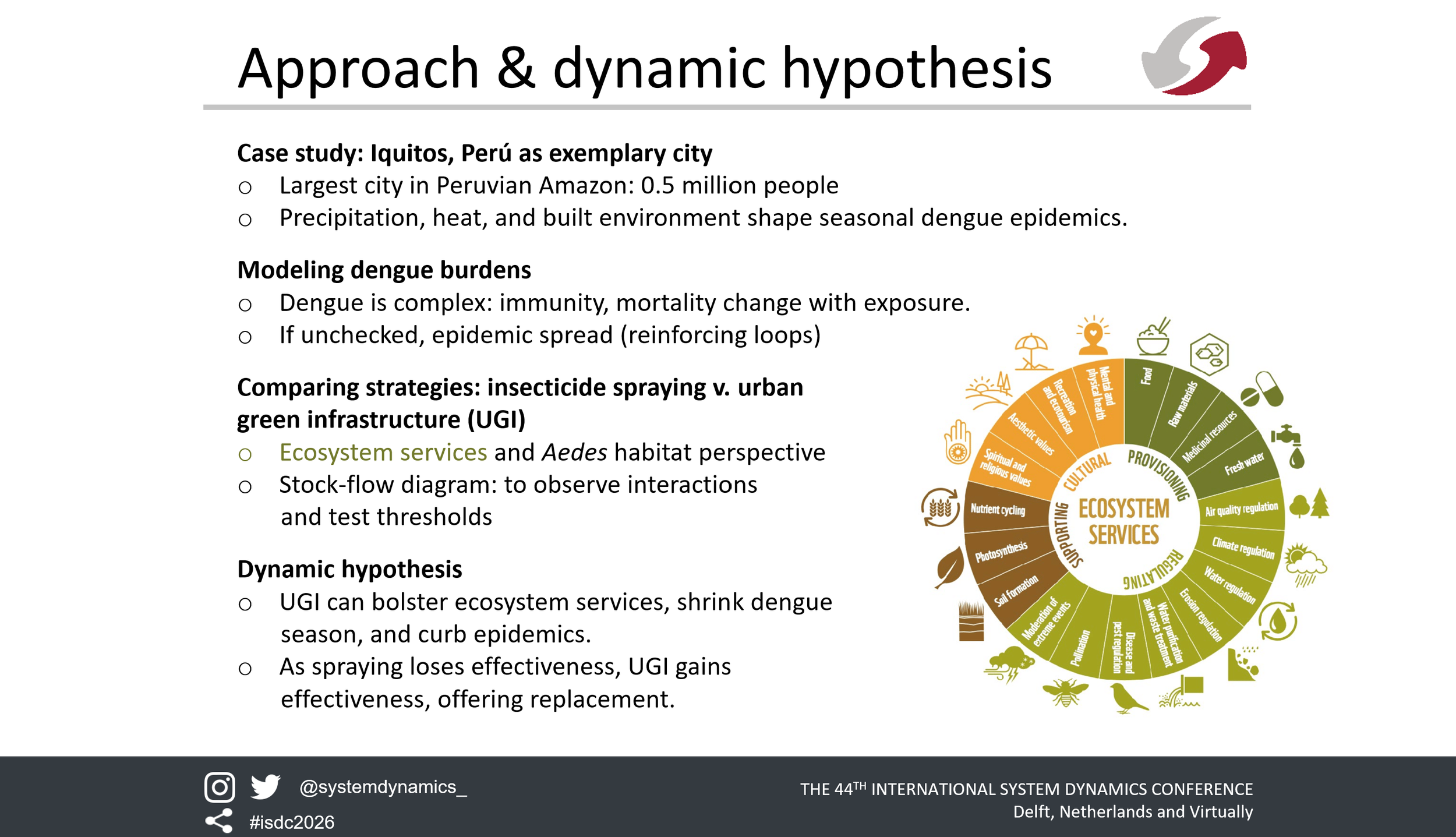
Dengue touches each of these aspects. For this reason, a landscape architecture approach is quite useful for thinking about dengue. I have come to believe that green infrastructure — one of the foci of landscape architecture — has the potential to affect dengue dynamics.
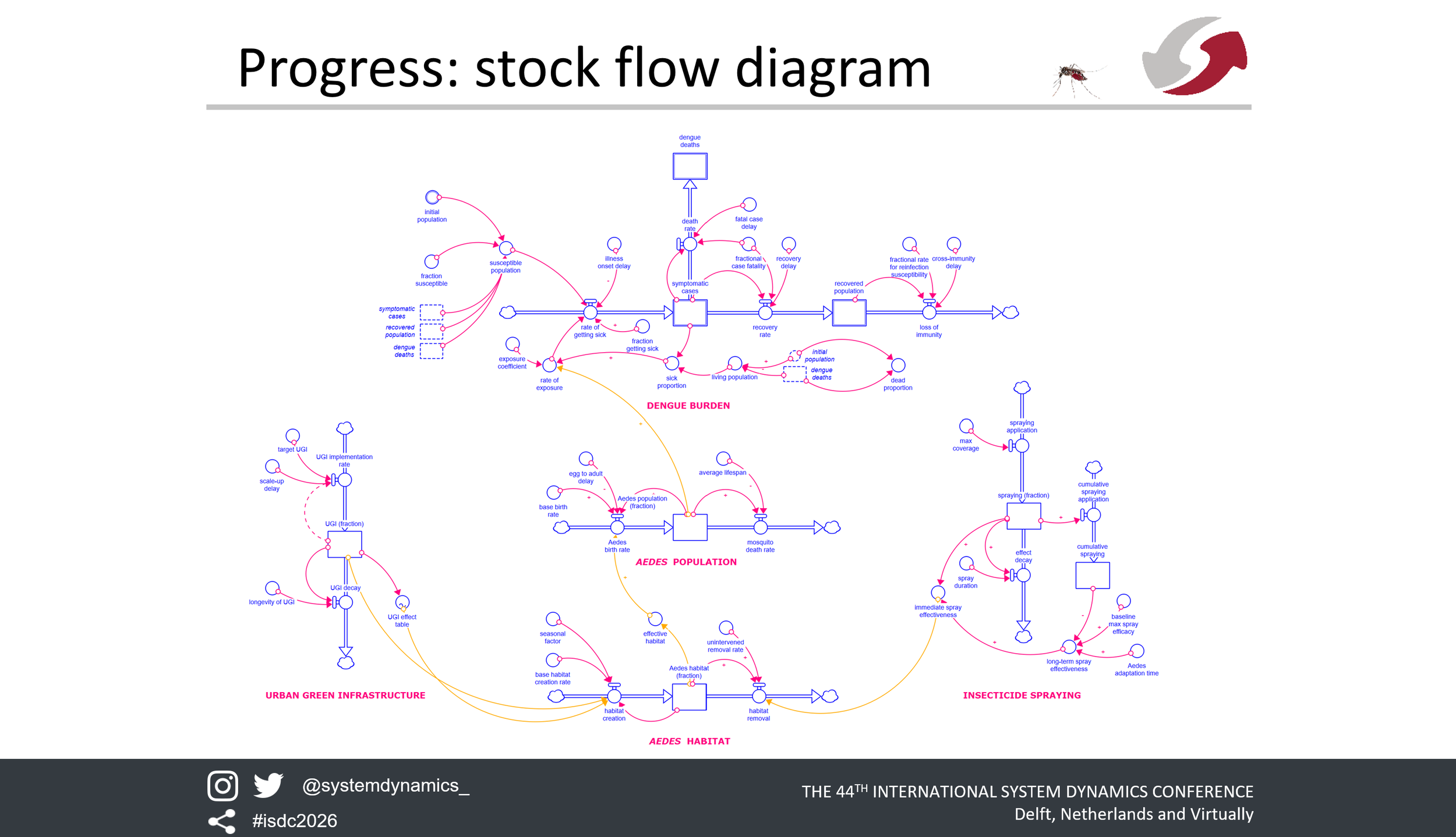
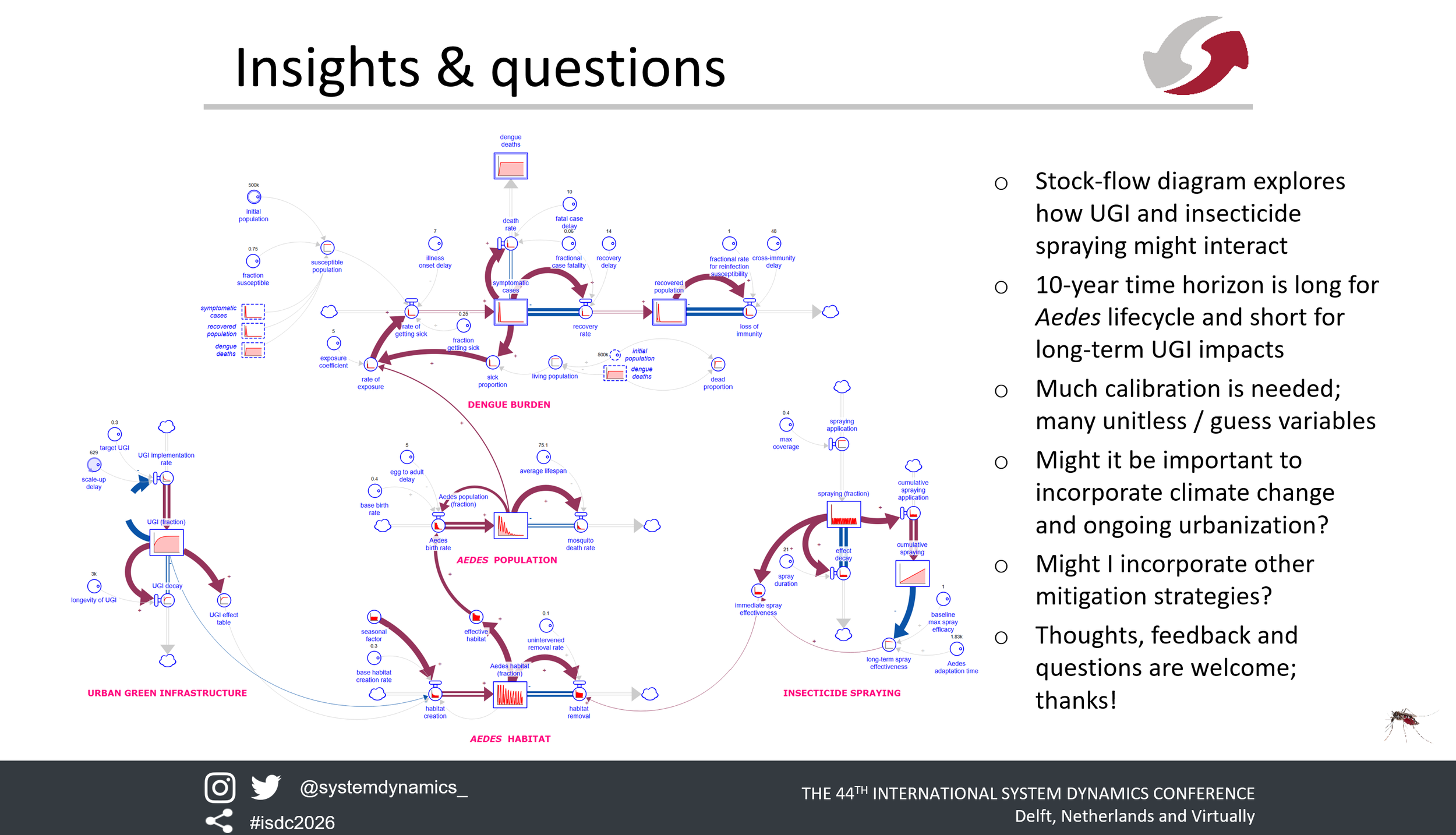
So I set out to build an sd model that could capture and test this. The model that I presented this morning at the international system dynamics conference this morning is a work in progress. It aims to represent relationships between dengue burdens, Aedes habitat, insecticide spraying, and urban green infrastructure. The model aims to deepen our questioning:
In addition to
what are the system dynamics of dengue?
we ask,
how effective are mitigation efforts?
what shapes their effectiveness (or lack thereof)?
how might we improve effectiveness?
I designed the model to show how insecticide spraying, though initially helpful, can slowly undermine itself, while other relationships move in the opposite direction. Investing in urban green infrastructure can strengthen ecosystem services over time, potentially reducing conditions that favor mosquito populations while creating broader environmental benefits.
in conclusion, for now…
The details of the model are topics I’ll explore in future posts. For now, see my slides below. This is a work in progress, so stay tuned.